Short answer: one missed day does not undo a habit you are building. In a well-known study of habit formation, a single missed day had little effect on how automatic the habit later became. What matters is restarting quickly, ideally the next day, with a version of the habit small enough that you will actually do it. Repeated misses are different: they add up, so the goal is to keep a miss from turning into a week.
What the research says about one missed day
Researchers at University College London followed 82 people for 12 weeks while they built a new daily habit, such as drinking water with lunch or going for a walk before dinner (Lally et al., 2010, European Journal of Social Psychology). They tracked how automatic each habit felt over time.
- Missing one opportunity had little impact on later progress (British Psychological Society summary).
- Many missed days, even spread out, did add up and lowered how automatic the habit became.
- The average time to reach a plateau was 66 days, with a very wide range between people (18 days to a projected 254 days). So if your habit still feels like effort after three weeks, that is normal.
The practical lesson: a broken streak is a number on a screen, not lost progress. Treat the next day as a normal day, not a failure to recover from.
The first 24 hours after a miss
- Don't double up. Doing two days' worth today makes tomorrow harder. Do one normal day.
- Name what got in the way. "I forgot" needs a better cue. "No time" needs a smaller version. "Wasn't near it" needs the habit tied to a place you are always in.
- Do the smallest version today. Two pages, not a chapter. Five minutes, not thirty.
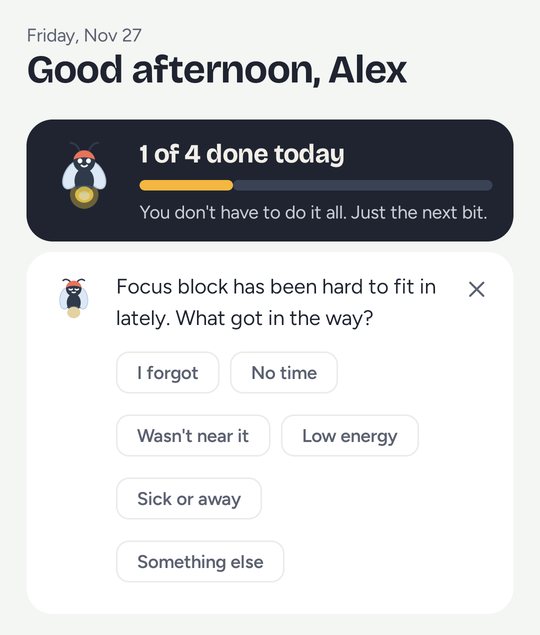
When a habit keeps slipping, our app asks what got in the way instead of only resetting a counter.
Shrink the habit to restart
A restart fails when it asks for the same effort that failed last time. Give each habit a busy-day version: the smallest thing that still counts. On a bad day, doing the busy-day version keeps the routine alive.
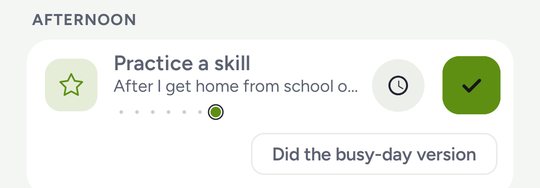
Marking a habit done, with the option to log the busy-day version instead.
Starting steps can be tiny. A ready-made reading plan in the app begins with two pages a day and a five-minute skill session, each tied to something you already do, such as finishing dinner or getting home.
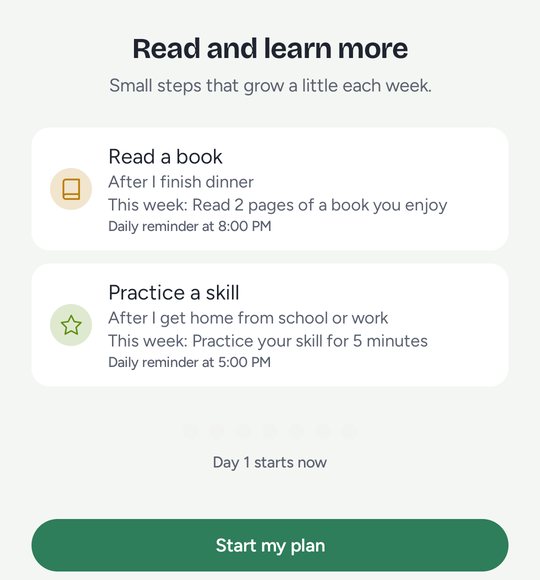
Small first-week steps, each linked to an existing routine.
Missed a whole week?
- Restart with one habit, not all of them. Add the others back once the first one feels easy again.
- Use the busy-day version for the first three days, even if you feel motivated.
- Move the cue if the old one stopped working. "After I sit down at my desk" is easier to keep than "sometime in the afternoon".
- Look at how many days you showed up, not only at the current streak.
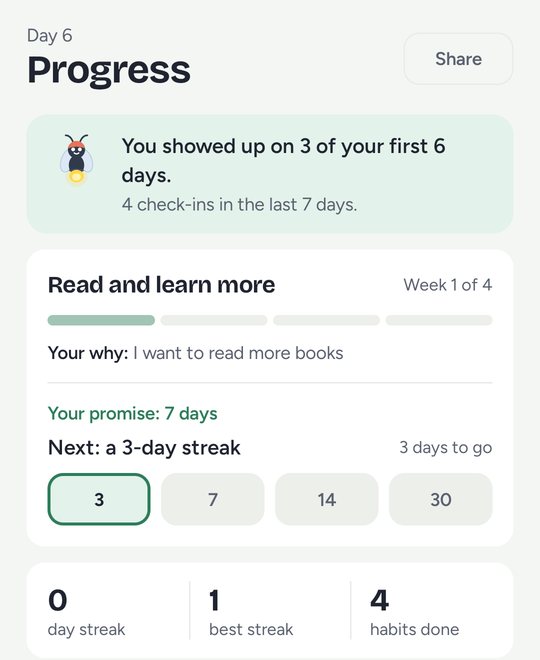
A streak of 0 next to "you showed up on 3 of your first 6 days". The second number is the more useful one when you restart.
How we tested
Screens are from Habit Tracker: AI Goal Planner on a Pixel 7 (Android 17), captured on November 27, 2026, using a test profile and a ready-made reading plan. AI plans, the coach and AI suggestions are Premium features; this guide only uses steps you can follow without them.

How this article was made
This article was drafted with the help of AI tools, then checked against the cited study and against the app screens shown. It is general information about building habits, not medical advice. More about how we write: About Ash Aqua Vision. More guides: all articles.